Jay Pottak (@_jaynkees_ on Instagram) is by far the most eloquent person I’ve interviewed thus far. Honestly, just read it.

Charlie – So firstly, I just want you to give me a little bit of your background in theater arts, set design.
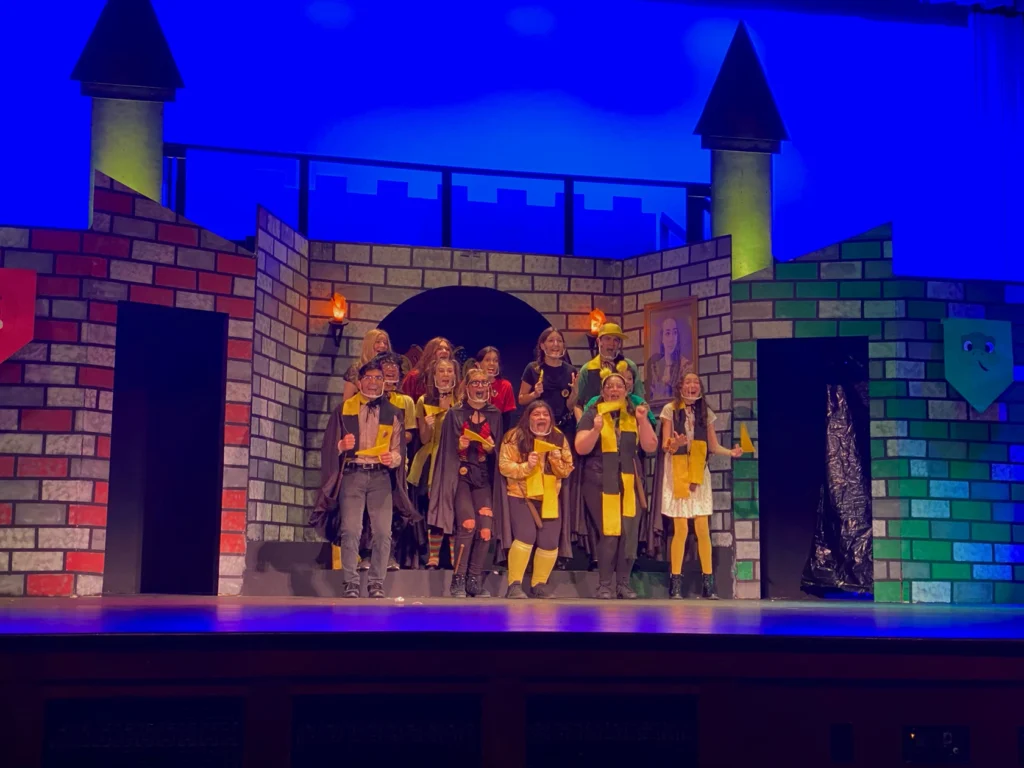
Jay – So I’ve been doing theater since my freshman year of high school. I didn’t really know anything about it, but my mom was like, “Oh, I did set crew, or stage crew in high school. You should try it out.” And I was like, “Okay, whatever.” I never really did a lot of extracurriculars before that. So I came in and I was like, “Hey, I want to do set crew, like backstage stuff, or, like, help build the sets.” And they were like, “Oh, sure, we’re doing Little Shop of Horrors.” That was the first musical I worked on, and I pretty much built that whole set by myself at like, the ripe age of 12 or 13, with help from two alumni and our technical director, Mark, Mark Palminteri. What a king. Love that guy. Shout out Mark. All through high school I worked on a bunch of shows, and then I went to college, and I was like, “Theater’s not a real job. I’m not gonna study theater.” I went to UAlbany for political science and I was like, Wow, this sucks! I don’t want to study politics anymore, like they just want me to be a congressman. I don’t want to do that. So I ended up talking to the President of the Musical Theater Association, which is the Student Run Club at UAlbany that puts on musicals every semester. And I was like, “Oh, do you guys need anything for the show you’re doing, Heathers?” And he was like, “We actually are looking for a spotlight operator.” And I said oh, hell yeah, because I did spotlight operating stuff for Blue and Gold, which is my high school’s big dance competition. So my senior year, I cued all the spots and, like, designed what they were going to be doing for this show. And I was like, man, I should have gone to school for theater. This is really what I love doing. I loved it all through high school, it was like, my thing. And I was like, “Shit, I can change my major to theater.” So I ended up studying theater and sociology. Sociology is just like, cool, but theater, like technical theater, is really what I want to do, just working with my hands to put on a show on stage. Like half the spectacle is what’s going on around the actors. Of course, the actors are a huge part of it, but there’s so much that goes into the technical aspects of it. And UAlbany didn’t have a crazy theater department. They lost a lot of funding in the last few years, so I had a tech minor, but then I was like, “I really want to transfer.” I had applied here out of high school, but it was too far away. Program is good, but like, I didn’t really want to do theater at that point. But then after my first semester, my sophomore year, I really want to, like, focus on what I need for myself. So yeah, after sophomore year, I transferred here for the theatrical production and design BFA, and that’s how I got here today.
Charlie – So at SUNY Fredonia, what productions have you worked on so far?
Jay – I have worked on Legally Blonde, which I was kind of thrown into as soon as I got here. I was backstage, running the flies so all of the scenery that comes in and out, like flying up and down backstage, that was me. And then I just worked on 12th Night, which I worked on some scenery for. Currently we’re working on next semester’s production of The Lightning Thief. I’m the assistant prop supervisor. And even though it’s next semester, many months ahead, we are already doing work on that. I have to actually do some work on that tonight.
Charlie – So far throughout high school, UAlbany, and Fredonia, do you have any favorite things that you have done? Anything that just really stands out?
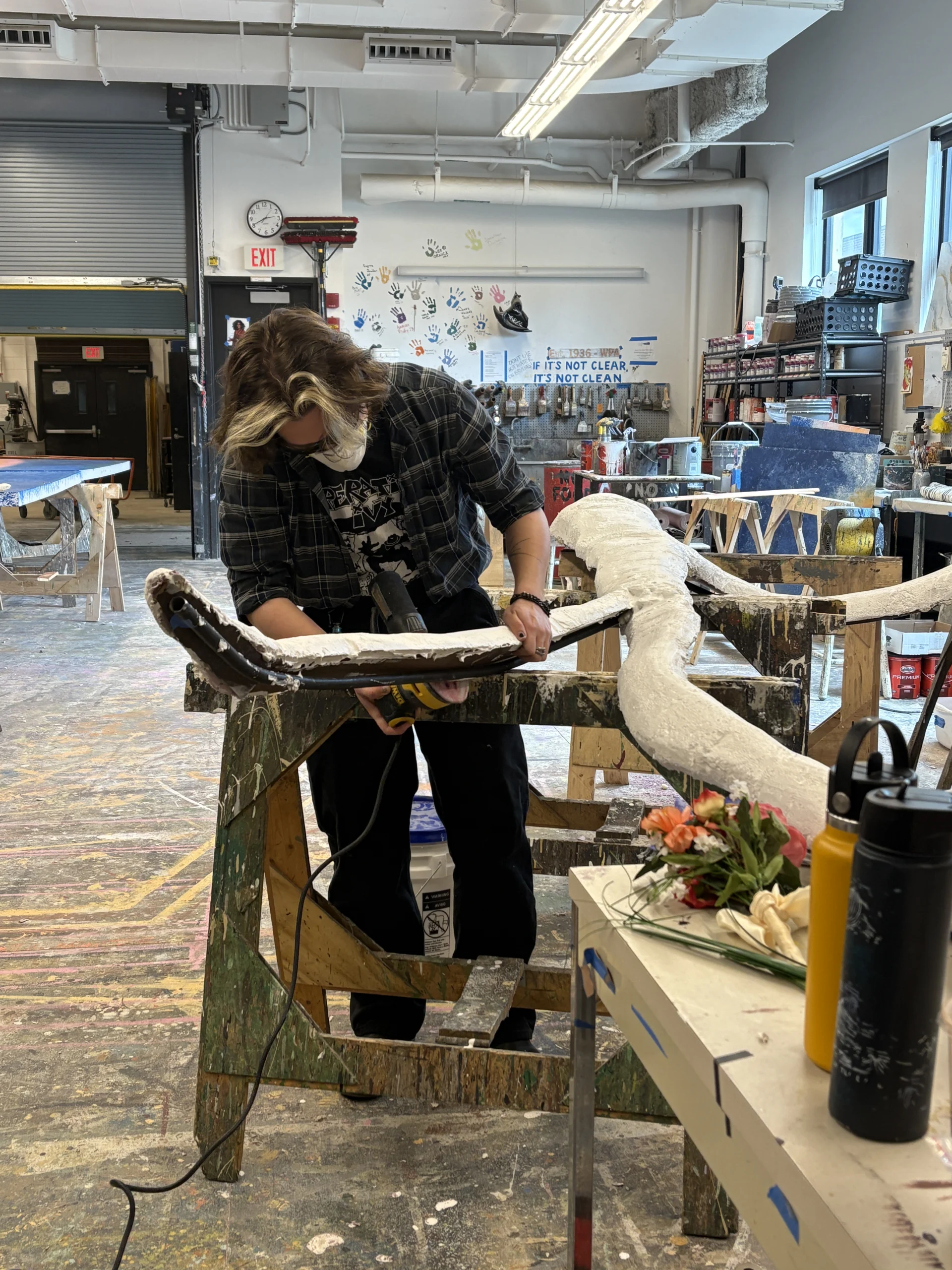
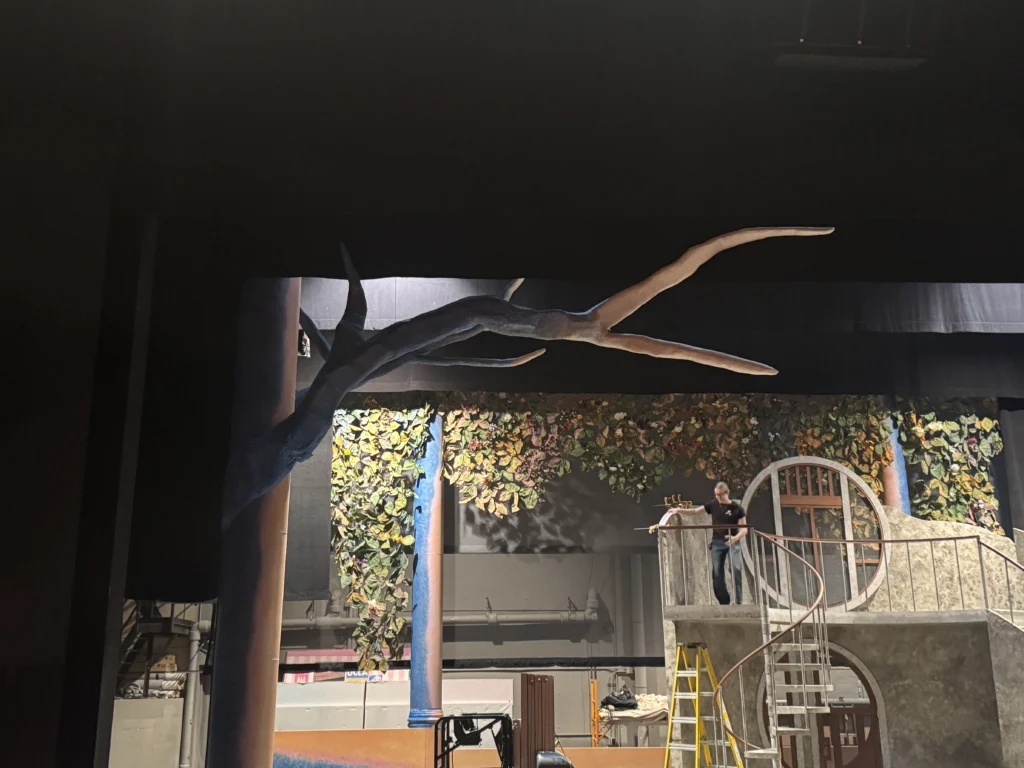
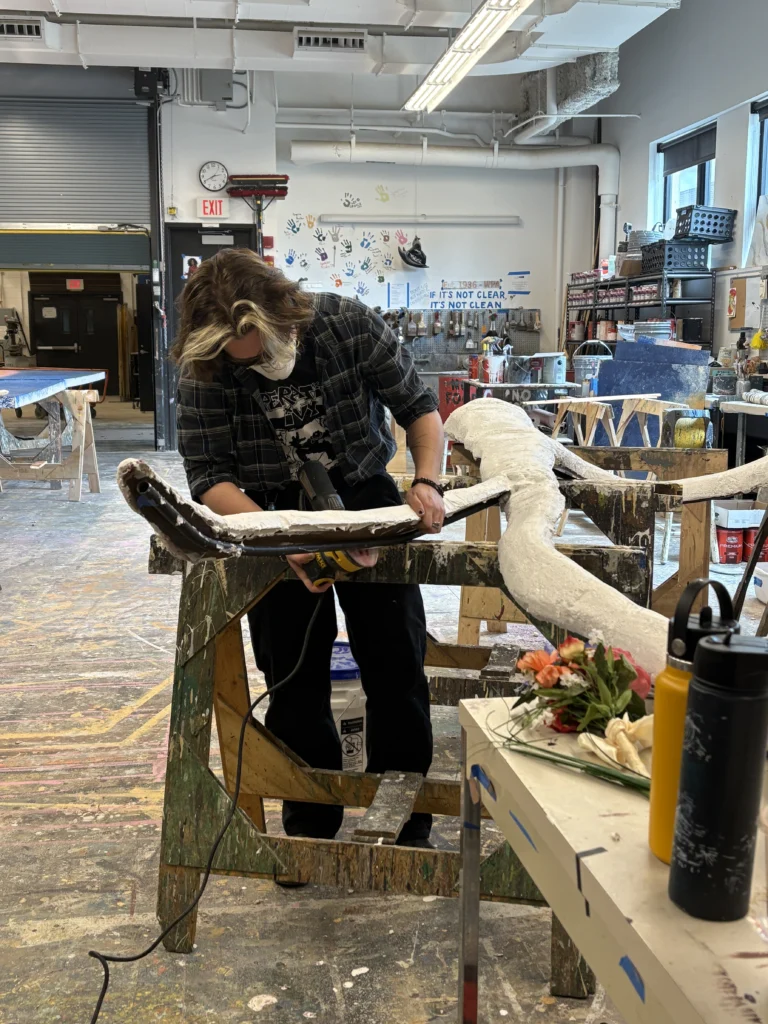
Jay – Yeah, I mean, for sure, most recently, when I was working on 12th Night, I was kind of thrown into it. I was originally just supposed to be a scenic painter, but then our technical director was like, “We need these big pieces of scenery, these big branches that are supposed to look like sculpted marble, like chiseled stone branches.” And I was like, “I want to do that.” Like hell yeah, that sounds awesome. And we were already, like, two or three weeks behind where they should have been. So I was working on them for five or six weeks, and I put in like 75 hours just on these two big ass branches. One was like 15 feet long, and the other one was like 25 and it was just like, such a fun experience. It was me and one other person, but I did, like a bulk of putting these things together. I got to weld bent steel pipes, and then face them with, like masonite boards, which is like a pressed wood fiber. And then we covered them with foam, like big pink polystyrene foam, and shaved it out, and, like, carved it to look like these big ass branches. And then we covered it with some waterproof sealer that they use on roofs. And it was just, like, awesome. And then they were painted, and it was great, and that was maybe a recency bias, but probably the coolest thing I’ve worked on.
Charlie – You mentioned that there seems to be a lot of times where you can get behind schedule, or you have tight deadlines to get these things done. Does the fun that you’re having outweigh the stress of that?
Jay – I think, honestly, a lot of the fun comes from the stress of it. That’s always been a big part of it for me, the adrenaline you get from like, “This needs to be done!” is kind of what drives me. And I’ve always been a bit of a procrastinator, but to work in a field that is so deadline heavy, I feel like that really pushes me to do the work. While it is super stressful, I think the payoff is just like, so great and so rewarding to see that on stage, even if people don’t notice it, there are people that do. And I notice it, so that is super rewarding for me. And I think I love working with my hands, so I think the fun of just putting shit together definitely outweighs that stress.
Charlie – This art form seems to blend a lot of different skills and techniques. Like you mentioned welding, you mentioned some sort of, you know, mechanical operation of the flyaways, as well as working with so many different materials and lighting. What are the biggest aspects that you have to consider when you’re designing a set, like, is it structural integrity? Is it how the light is going to hit it?
Jay – I mean, there’s so much that goes into it. I haven’t even, like, scratched the surface of all these things, but there’s, you know, we have a technical director who is in charge of building everything. He oversees everything that you would see as a scenic designer. And he’s like, Well, we can build this like this. But most recently, it was a walkway that was too thin. This walkway needs to be three feet wide, and we need a railing at this height because it’s a safety hazard, if not, so, like, you definitely need to consider safety and, like, the structural integrity when you’re designing these things.We go through so many different meetings and there’s, like, first proposal, preliminary design, final design, and then, like so much in between that. So there is a lot of deliberation that goes into this, and then the lighting is definitely not an afterthought. It’s considered throughout the whole process, but you kind of have to have the lighting work with what’s built. You can’t really have what’s built work with the lighting. Not in every case, but it’s definitely still a level of involvement between every section of what you’re working on.
Charlie – Yeah. Okay, totally makes sense. That flows well into one of my other questions, which is about the collaboration between the set designers and other crew members. Where does everybody else come into this? Like, what does it look like between directors, producers, actors and then the people who work the more physical side of it?
Jay – Yeah, I think, I think at its core, theater and performance is a collaborative art form. There is no individual when you’re working on any show of any scale, you know. Even if there’s only one person on stage you know, there’s still a whole team behind them. Like there’s a lot of conversations, and questions asked. Like a director knows what artistic direction they want to bring a piece in, but they might not know what’s possible in lighting or in scenery and technical direction. You know, what’s possible to bring on stage? How do we bring this story to life? There’s so much that is considered, so many ideas that are just like thrown out until you can see what finally sticks there. Getting a good director that is really strong in their vision is important because it gives you some sort of guiding direction on where you want to go, as far as scenery or lighting. You know, those ideas you want to bring, because everything is such as art, like, everything brings a certain feeling to the stage. Everything is thought out. There aren’t things that are just like, “We’ll just do this”, it’s like, we just need to do this. We need to do this because it works. But there’s nothing that’s just like, “Sure, let’s just throw this around.” Because everything has some weight to it, and what’s involved, like, how it goes on stage.
Charlie – I love stuff like that, where every little thing has something behind it. I love that. So moving in a little bit of a different direction. Where does your personal style, artistically, shine through within your work behind the scenes? If at all?
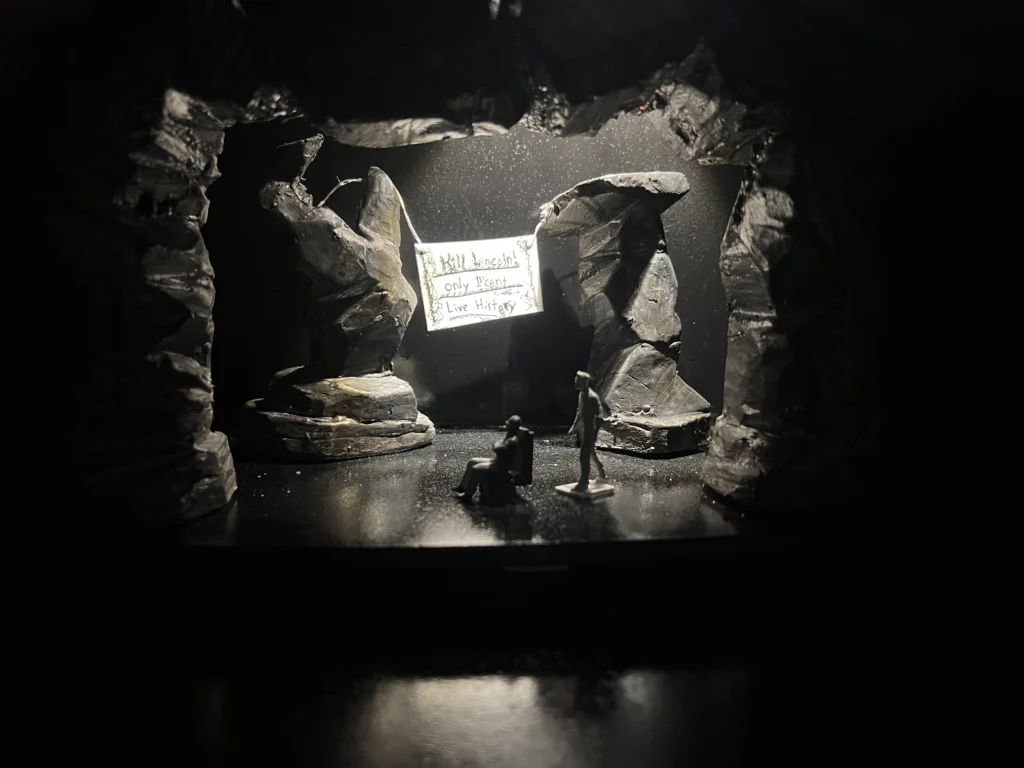
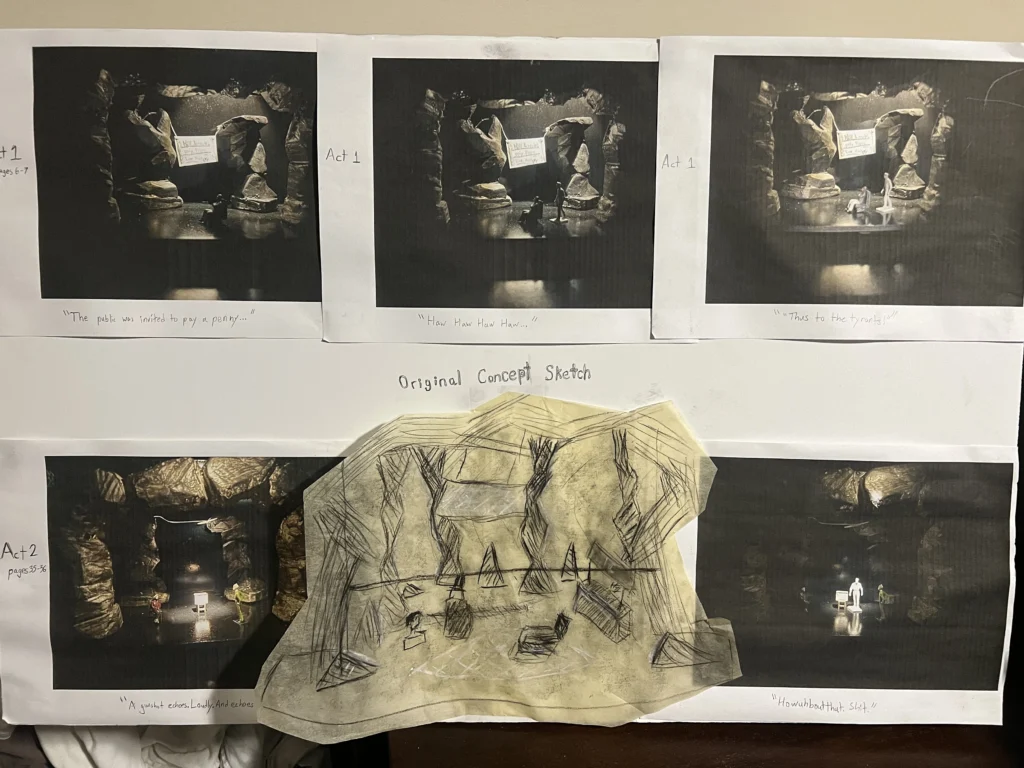
Jay – I don’t know if my particular personality, my style, has come through in a lot of the stuff I’ve worked on, maybe some classwork stuff, but nothing that’s really been on stage has had a whole lot of my personality in it. I’ve definitely worked on a lot of things, but nothing of my own true original creation I had to make. When I was at Albany, I had a class that was studio skills. And my final project was a model box that we built in class. You’re given a show, and you have to make a set and talk about how it relates to your idea, your vision, of this show. So I did a set for the play, The America Play by Susie Lori Parks, which is a super surrealistic kind of absurd play that takes place in the great whole of American history, which is nothing and everything at the same time. It’s where all the untold stories of what happened to create America as we know it. You know, it follows this guy who is the founding father. He is an African American grave digger who people tell him he looks like Abraham Lincoln all the time. So he’s like, “All right, well, I’m gonna be Abraham Lincoln.” He is an impersonator, and lets people pay him, I think it’s a penny, to reenact the assassination of Abraham Lincoln, which is crazy. But the story is just like, to me, it was so important, even though it’s so confusing. But like the revisionism of history, and like being able to tell the stories that are untold, even if it’s, you know, a fictional story, it carries that message of, like the history that’s swept under the rug, you know, the not so pretty pieces that you aren’t taught about. And as a classical punk as I call myself sometimes, um, I think being able to put that on display was a really proud moment for me. Um. Yeah, and my set for it was pretty simple, but just, like, very jarring and definitely inspired by the art that I like. Kind of abstract and jaded and, like, stabbing. The outline of the proscenium, which is the opening of the stage, was meant to look like rocks that were man made or carved by man in a super unnatural, like uncomfortable way, with just a single chair in the middle of the set where The Founding Father would sit, and just like there was a character that walks up behind him and just shoots him, and the whole stage goes black.
Charlie – You seem to be inspired by more surreal, very sharp, very visceral plays. Are there any dream productions that you would love to work on that fit that aesthetic?
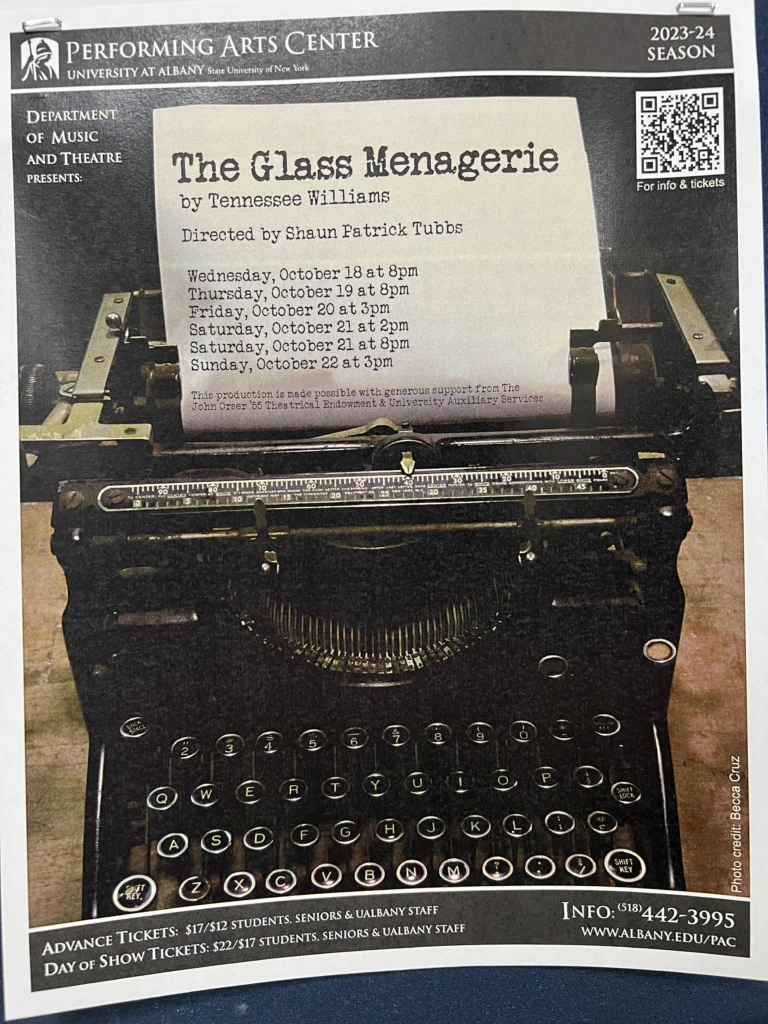
Jay – Oh, yeah, for sure, I am more a fan of a straight play as compared to a musical. At Albany last year, we did a production of The Glass Menagerie by Tennessee Williams, American playwright, and it’s just like a story of this broken family with an alcoholic son and an overbearing mother and a disabled daughter who is struggling with the overbearing mother and the like, kind of absent brother, but she’s still trying to be herself throughout that, and just like that family dynamic kind of brought me home. I actually sent my sister a copy of that play after we did it, because I was like, “You should read this.” It reminds me of my mom. That play is described as taking place in a memory. So it’s kind of this dreamscape, like illusionary, your narrator is unreliable. All of these things are a memory. It could be misremembered. It could be, like, purposefully inserted with, like false memories or whatnot, and just the creative liberty of, like, “This exists within a memory”, really drew me in, because memory is such a human facet, like you can’t physically describe or physically show what a memory is. So doing it in live theater makes it such a unique form and medium to convey such an idea, which I just find super interesting.
Charlie – Do you have any interest in designing sets for on screen productions?
Jay – Yeah, for sure. I think anybody who goes into studying theater kind of has to think about film and TV, because Broadway is super exclusive, and a very hard industry to get into, specifically. I’m lucky enough to be from Long Island, so I’m pretty close to Broadway/New York City, so I would love to work on Broadway, but I think stage and film is absolutely a considerable option when it comes to that point and deciding a career, I would not be opposed to working on that kind of stuff
Charlie – Where do the two intersect? [On screen vs. off screen production set design]
Jay – Well, at least for scenery sake, which is what I want to do, every film set/TV set needs scenery if they’re not shot on location or in a prefabricated building where our set is already there. Like every sitcom set, you would need a designer and people to work on that scene, like carpenters, and then you have people that are in charge of props and stuff like that that go into it. So there is absolutely a huge intersection between movie and TV and then the on stage side of theater, especially for scenery.
Charlie – Would you say that theater is a little freer? Because, you know, people are sitting there watching a live performance, knowing that, like, everything is not real, so do you maybe get a little more freedom to make it more whimsical?
Jay – Oh, yeah, absolutely, you have a lot more creative liberty and, like, artistic freedom when it comes to presenting something on stage, because you can put something here [on stage] and be like, “This is a TV”, and there’s like, nothing there. It’s just, like a floating screen, or you’re just looking at a cabinet with nothing on top of it, but the characters are sitting around it like it’s a TV. You don’t have to fully have that visual element that you would need in television [productions], or like in a movie, where you need every single piece of this scene to make sense, because the people [in the audience] already have that pre established notion that this is on stage, these are actors, yeah, but they’re in their world. We’re watching it as an outside observer, so you kind of have that creative space for the audience to imagine what else is going on around them.
Charlie – For my last question, I just thought I would ask, What do you think people misunderstand the most about your work?
Jay – That’s hard, because I’m not those people, right? I mean, even, even that last aspect that we just talked about, the notion that this is on stage, this is a performance that you’re viewing in the moment, I feel like a lot of people, even though, as a theater person, I have that understanding, a lot of people might not. There might be that, that gap of, like, what’s going on? Like, what do they do? Like, why are they pretending the phone is ringing or something like that, you know, like, the phone is ringing. So there’s a phone ringing somewhere, but, like, I don’t hear it, I feel like that can definitely be misinterpreted, or like the aspect of the scenery isn’t always full scenery, like sometimes you’ll just have like a floating window as A wall instead of like a full constructed box set, is what it’s called when you have the three walls. So there’s definitely a lot of the creative gap, I would say, between the standard viewer and someone who is like an avid theater goer or works in the theater industry.